
The Commission for Air Quality Management (CAQM) has implemented Stage 1 of the Graded Response Action Plan (GRAP) in Delhi-NCR after the Air Quality Index (AQI) deteriorated to the 'poor' category. Forecasts indicate the AQI will remain poor in the coming days, triggering restrictions like banning coal and firewood in eateries and limiting diesel generator use.

Heavy rainfall has disrupted major pilgrimages in Uttarakhand, including the Kedarnath route and the Kailash-Mansarovar Yatra, prompting the IMD to issue red and orange alerts for extremely heavy rainfall across several districts.

The water levels in the Bhotekoshi River rose again on Sunday, days after a devastating flash flood struck Nepal, authorities warned, urging residents and rescue personnel in flood-hit districts to remain alert.

India's peak power demand reached an all-time high of 257.37 GW on Monday, driven by increased use of cooling appliances during an intense heatwave, according to power ministry data. The Indian Meteorological Department has forecast continued heatwave conditions in northwest and central India.

This was the fourth-lowest rainfall since 2001 and the 13th lowest since 1901, under the impact of El Niño.

Rainfall during the monsoon season so far, from June 1 to September 13, has been 15 per cent below normal.

Heavy rainfall has severely impacted Uttar Pradesh, Jharkhand, and Uttarakhand, leading to casualties, widespread flooding, and significant disruptions. The Char Dham Yatra was suspended, flights were cancelled, and standing crops were damaged. Other regions like Himachal Pradesh, West Bengal, Rajasthan, and Delhi also experienced varied weather conditions, including snowfall and light rains.

The death toll from flash floods in central Nepal has surged to 734, with nearly 2,500 people still missing. India has intensified its rescue and relief efforts, sending additional aid, technical teams, and forensic experts, while also working to locate and rescue over 275 missing Indian nationals.

The devastating flash floods wreaked havoc across Nepal, with the ministry of external affairs on Thursday stating that 84 Indian nationals have been rescued while 290 remain uncontactable as the Himalayan nation stepped up search, rescue and relief operations following the disaster that has claimed more than 390 lives.

Punjab Kings face Mumbai Indians in a crucial match in Dharamsala, but the weather forecast threatens to disrupt their playoff hopes.

The administration has been put on high alert following the India meteorological department's (IMD) forecast of extremely heavy rainfall across several districts of Gujarat in the next two days.

Several parts of India are experiencing a severe heatwave, with temperatures soaring past 44 degrees Celsius. States are issuing alerts and taking measures to protect people and animals from the extreme conditions.
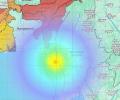
An earthquake of magnitude 6 with its epicenter in Myanmar jolted Kolkata and its adjoining areas, causing tremors and concern among residents.

The death toll from devastating flash floods in Nepal has surged to 1,050, with nearly 4,000 people, including foreigners and security personnel, still missing. Rescuers are struggling with intermittent rainfall, rising river levels, and difficult terrain, while expert teams from India and China assist in operations, particularly at hydropower project sites where many workers are believed to be trapped in tunnels.

Nepal's former Forest and Environment Minister Madhav Prasad Chaulagain has expressed concern over the lack of timely information exchange with China ahead of the devastating floods, stating that the disaster's scale could lead to an 'unbelievable' rise in the death toll.

The India Meteorological Department (IMD) has forecasted an early onset of the southwest monsoon over Kerala, expected around May 26. This marks the beginning of the crucial rainy season for India.

Prime Minister Narendra Modi has urged Indian citizens to take precautions during the ongoing heatwave, emphasising hydration and care for vulnerable individuals and animals.

Several districts in central and south Gujarat received heavy rainfall on Friday with over 1,500 persons evacuated to safer places in Surat which is the worst-affected, officials said.

Heavy monsoon rains have caused widespread havoc across Arunachal Pradesh, leading to floods, landslides, and significant damage to infrastructure. Rescue operations are underway in multiple districts, with casualties reported and many displaced. Connectivity remains severely disrupted, and authorities have issued warnings as more heavy rainfall is forecast.

The Centre has reviewed the monsoon situation, noting a reduced rainfall deficit and ongoing preparedness for the kharif season amidst El Nino concerns. A high-level meeting chaired by the Principal Secretary to the Prime Minister discussed measures across various sectors, emphasising continuous monitoring and coordinated action to mitigate potential impacts on agriculture, water resources, and essential commodities.

Indian benchmark stock indices, Sensex and Nifty, experienced a significant decline for the third consecutive day, with the Sensex tumbling 1,092 points and Nifty closing below 24,550. This downturn was primarily driven by the India Meteorological Department's forecast of a below-normal southwest monsoon and ongoing geopolitical uncertainties surrounding the US-Iran ceasefire arrangement.

With the southwest monsoon stalled over southern Maharashtra, India is facing a nationwide rainfall deficit of 41 percent between June 4 and June 18, according to the latest India meteorological department (IMD) data.

The monthly average rainfall over India is expected to be below normal during July, the India Meteorological Department said on Tuesday in its monthly forecast.

Gujarat has reported 35 rain-related deaths in the past two days, primarily in the worst-affected districts of Valsad and Navsari, as floodwaters recede and authorities initiate damage assessment surveys and post-flood cleanliness drives.

Climate experts explain how El Nino and climate change are intricately linked, with El Nino delaying monsoon onset and climate change intensifying rainfall. This new reality is altering the Indian monsoon's behaviour, leading to short-duration, high-intensity rain spells, especially in western and northwestern regions.

JPMorgan has downgraded Indian equities to 'neutral' from 'overweight', citing elevated valuations, rising earnings risks, and limited exposure to next-generation technology like AI. The brokerage believes other emerging markets offer more attractive risk/reward propositions despite India's strong structural growth story.

Nepal is grappling with one of its worst disasters in recent years as massive flash floods, triggered by an ice avalanche, have claimed 270 lives and left thousands missing across multiple districts, prompting urgent rescue and relief operations.

Most north Indian states reported below-normal temperatures on Monday, with rain and thunderstorms lashing parts of Uttar Pradesh, Rajasthan, and Himachal Pradesh. The southwest monsoon is expected to arrive in Kerala in the next two to three days.

A massive flash flood originating in Tibet has devastated central Nepal, killing 17 people and leaving nearly 500 missing, including 105 Indians. The deluge, caused by a rock slide near the Nepal-Tibet border, swept through districts, washing away bridges and severely damaging at least a dozen hydropower projects.

A new report by child rights NGO CRY reveals that nearly seven in every 10 school-going children across India missed school or routine activities from May to June this year due to extreme heat, with 76 per cent reporting negative impacts on their ability to focus on studies.

India's hydropower generation has been significantly constrained in July due to the El Nio effect, which has weakened the southwest monsoon and reduced reservoir levels. This decline, following a 21 per cent year-on-year drop in June 2026, is forcing greater reliance on coal generation and straining grid flexibility amidst rising power demand.

"Rather than worrying, preparation is required. Contingency plans will be made for affected districts and crop changes will be considered wherever necessary"

Mahindra & Mahindra (M&M) is expanding its farm equipment strategy beyond tractors to include a wider range of mechanisation solutions like harvesters, balers, seed drills, and telematics-enabled services, aiming to capitalise on the growing demand for rental services by rural entrepreneurs and address low mechanisation levels in Indian agriculture.

Researchers at IIT Bombay have discovered that heatwaves in the Indo-Gangetic Plains are primarily caused by local land and weather conditions, rather than hot air originating from elsewhere, emphasising the need for location-specific early warning systems.

A new study indicates that India's monsoon season could experience a significant increase in uncompensable heat stress under a 2 degrees Celsius global warming scenario, extending the duration of extreme heat conditions.
The India Meteorological Department (IMD) has predicted below normal monsoon rains for India this year, citing the potential emergence of El Nino conditions. This could significantly impact the country's agriculture-dependent economy.

India is likely to witness a mixed temperature pattern along with wetter-than-usual conditions in May, with the India Meteorological Department (IMD) indicating that rainfall across the country is "most likely to be above normal" at over 110 per cent of the long period average (LPA).

'During the hot season (April to June), above-normal minimum temperatures are likely over most parts of the country, except in some regions of Maharashtra and Telangana, where minimum temperatures are expected to be normal to below normal,' IMD said.
Unseasonal rainfall could damage standing wheat crops, especially late-sown fields nearing maturity and grain-filling stages.

Several states in north India, including Rajasthan and Himachal Pradesh, experienced varied weather conditions, including light to moderate rainfall, fog, and temperature fluctuations.
